Charitable Giving Funds vs. Private Foundations
The Community Foundation provides a personal, local and flexible approach to giving. As you consider if this approach is better suited to your giving goals when compared to the establishment of a private foundation, we are here to help.
"Working with the Community Foundation gives us trusted, local expertise that allows us to stay focused on what we do best — showing up for our communities and making a difference where it matters most."
- Darren Rebelez, president and CEO of Casey’s
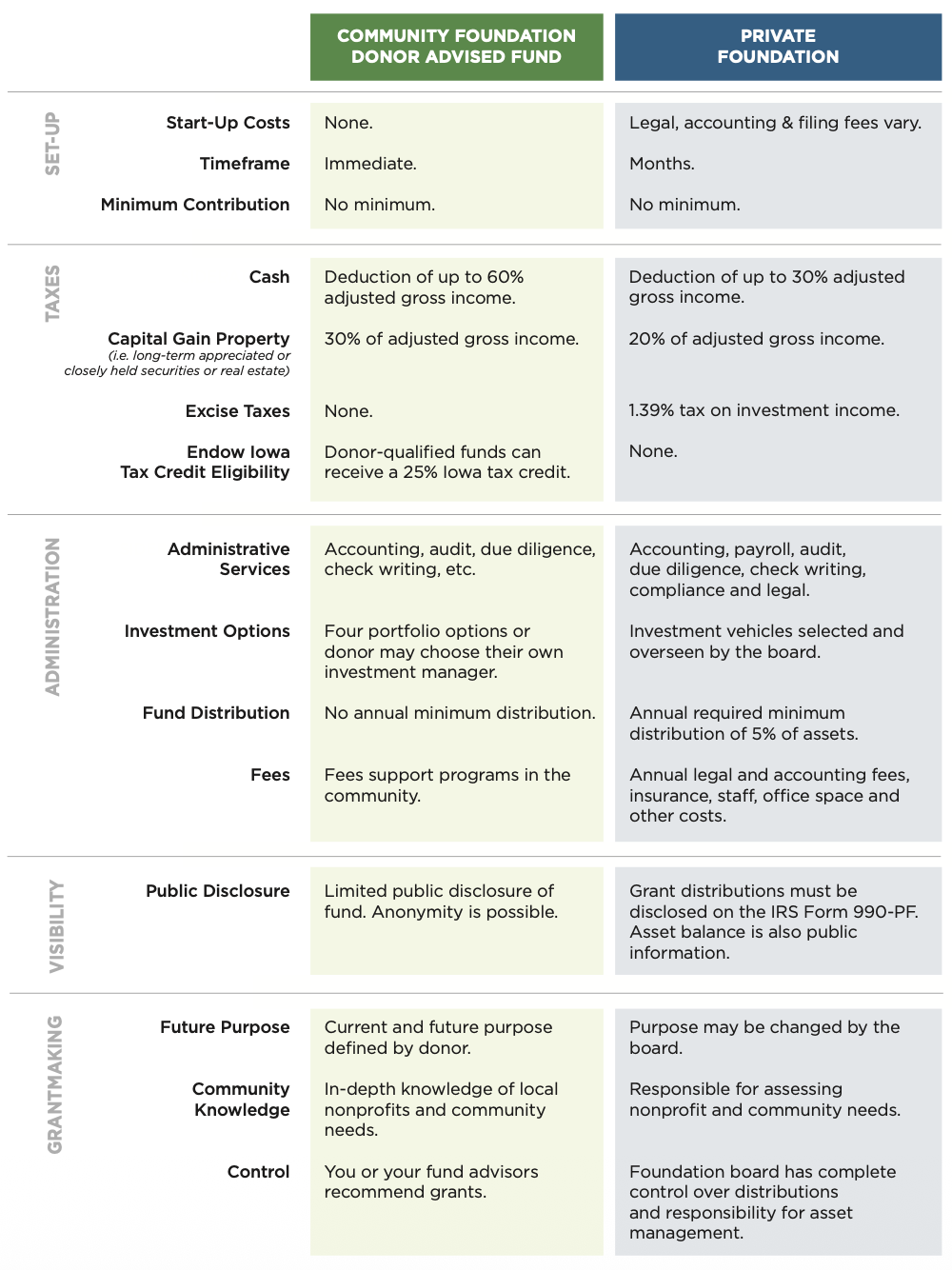
| Accounting, audit, due diligence, check writing, etc. |
| Four portfolio options or donor may choose their own investment manager. |
Investment vehicles selected and overseen by the board. |
| No annual minimum distribution. |
Annual required minimum distribution of 5% of assets. |
| Fees support programs in the community. |
Annual legal and accounting fees, insurance, staff office space and other costs. |
| VISIBILITY |
Community Foundation
Donor Advised Fund |
Private Foundation |
| Public Disclosure |
Limited public disclosure of fund. Anonymity is possible. |
Grant distributions must be disclosed on the IRS Form 990-PF. Asset balance is also public information. |
| GRANTMAKING |
Community Foundation
Donor Advised Fund |
Private Foundation
|
| Future Purpose |
Current and future purpose defined by donor. |
Purpose may be changed by the board. |
| Community Knowledge |
In-depth knowledge of local nonprofits and community needs. |
Responsible for assessing nonprofit and community needs. |
| Control |
You or your fund advisors recommend grants. |
Foundation board has complete control over distributions and responsibility for asset management. |
| Set-Up |
Community Foundation Donor Advised Fund |
Private Foundation |
| Start-Up Costs |
None. |
Legal, accounting & filing fees vary. |
| Timeframe |
Immediate. |
Months. |
| Minimum Contribution |
No minimum. |
No minimum. |
| Taxes |
Community Foundation Donor Advised Fund |
Private Foundation |
| Cash |
Deduction of up to 60% adjusted gross income. |
Deduction of up to 30% adjusted gross income. |
Capital Gain Property
(i.e. long-term appreciated or closely held securities or real estate) |
30% of adjusted gross income. |
20% of adjusted gross income. |
| Excise Taxes |
None. |
1.39% tax on investment income. |
| Endow Iowa Tax Credit Eligibility |
Donor-qualified funds can receive a 25% Iowa tax credit. |
None. |
| Administration |
Administrative Services |
Investment Options |
Fund Distribution |
Community Foundation
|
Accounting, audit, due diligence, check writing, etc. (fees vary) |
Four portfolio options or donor may choose their own investment manager |
No annual minimum* |
| Private Foundation |
All costs including payroll, audit, compliance, legal, etc. are responsibility of the private foundation |
Investment vehicles selected and overseen by board |
Annual required minimum payment of 5% of assets |
| Commercial Gift Fund |
Accounting, audit, due diligence, check writing, etc. (fees vary) |
Multiple options, in most cases |
May require a minimum of 5% payout |
*Endow Iowa funds are limited to a 5% maximum payout.
| Visibility |
Public Disclosure |
Community Foundation
|
Limited public disclosure of fund (anonymity is possible) |
| Private Foundation |
Grant distribution must be disclosed on the
IRS form 990-PF
Asset balance is also public information
|
| Commercial Gift Fund |
Limited public disclosure of fund (anonymity is possible) |
| Grantmaking Capabilities & Restrictions |
Future Purpose |
Community Knowledge |
Flexibility of Grants |
Community Foundation
|
Current and future purpose defined by donor |
Expert knowledge of local nonprofits and community needs |
Broad flexibility |
| Private Foundation |
Purpose may be changed by the board |
Responsible for assessing nonprofit and community needs |
Determined by board |
| Commercial Gift Fund |
Current and future purpose defined by donor |
Limited to no knowledge of local nonprofits and community needs |
Broad flexibility |